


Tracking your state income tax refund requires visiting your state’s Department of Revenue website and entering your Social Security number, filing status, and expected refund amount. Most states provide real-time refund status updates through dedicated online portals, with e-filed returns typically processing in 7 to 21 days and paper-filed returns taking 6 to 12 weeks. At Brilliant Tax & Accounting Services, we walk clients through this process every tax season — because knowing where your refund stands eliminates unnecessary stress and helps you plan ahead. Here is the step-by-step process for checking your state tax refund status and what to do if something looks off.
Step-by-Step Process for Checking Your State Tax Refund
Checking your state tax refund status follows a consistent process across most states, though each state uses its own portal and terminology. We recommend following these five steps to get a clear, accurate update on your return.
Step 1: Identify Your State’s Tax Portal
Every state with an income tax operates its own refund tracking portal through its Department of Revenue or equivalent agency. Visit your state’s official government website and look for a “Where’s My Refund?” or “Check Refund Status” link. Avoid third-party websites that may collect personal information without providing accurate data.
Step 2: Gather Your Information
You will need three pieces of information to access your refund status: your Social Security Number (or ITIN), your filing status (single, married filing jointly, head of household), and your exact expected refund amount as shown on your filed return. Having your completed return nearby makes this simple.
Step 3: Enter Your Details and Check Status
Input your information into the state portal’s secure form. The system will return one of several statuses: received, processing, approved, or sent. Some states provide an estimated deposit date once the refund reaches “approved” status.
Step 4: Note Your Refund Method
If you selected direct deposit during e-filing, your refund will arrive faster than a mailed check. Direct deposit refunds typically post 1 to 5 business days after the state approves the refund. Paper checks can take an additional 1 to 3 weeks after approval.
Step 5: Check Back if Needed
State portals update on different schedules — some daily, others weekly. If your return shows “processing” for longer than the expected timeline, check back after 48 to 72 hours before taking further action.
Key Takeaway: Track your state income tax refund by visiting your state’s Department of Revenue portal with your Social Security number, filing status, and expected refund amount — e-filed returns typically process in 7 to 21 days with direct deposit arriving 1 to 5 days after approval.
Common State Tax Refund Portals
State departments of revenue each maintain separate refund tracking tools. The following table provides direct access points for the most commonly used state portals so you can check your state tax return status quickly.
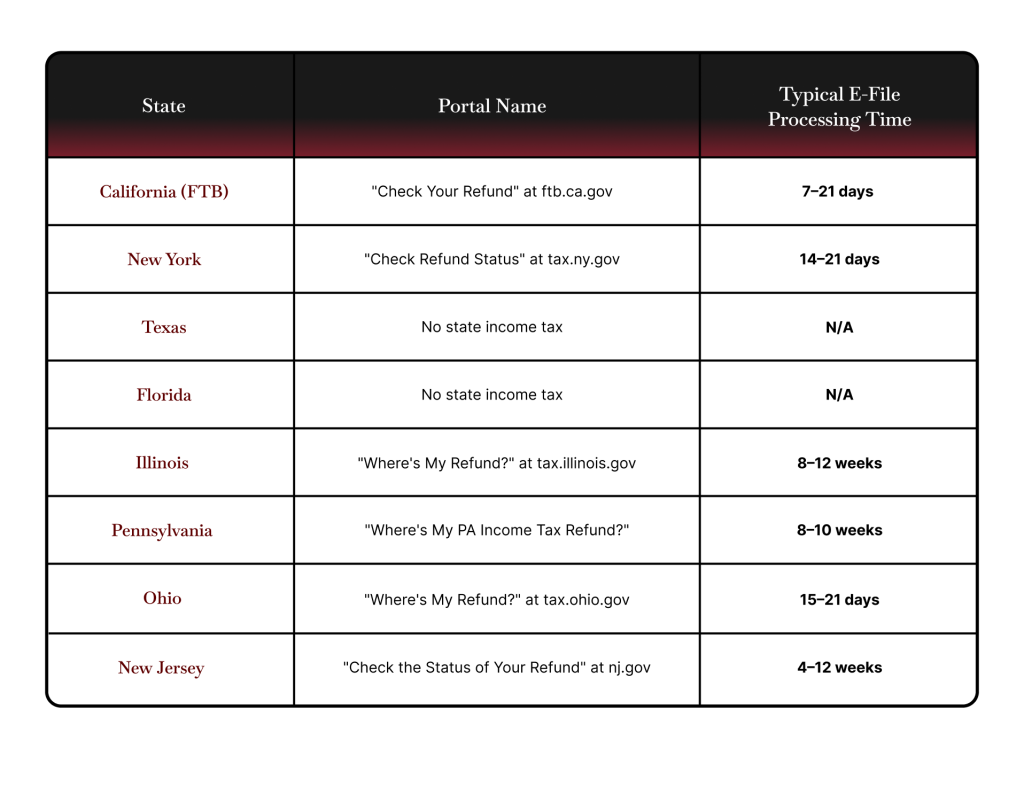
Note that processing times vary based on filing volume, return complexity, and whether the state selects your return for additional review. We recommend checking your specific state’s portal for the most current timeline data.
Key Takeaway: Each state operates its own refund tracking portal with processing times ranging from 7 days (California e-file) to 12 weeks (Illinois, New Jersey) — always use your state’s official Department of Revenue website for accurate status updates.
Expected Refund Timelines: E-File vs. Paper Filing
E-filed state tax returns process significantly faster than paper returns across every state. The IRS Where’s My Refund tool tracks federal refunds, but state refunds operate on separate timelines managed by your state department of revenue. Understanding these timelines helps you plan without unnecessary worry.

Selecting direct deposit during filing accelerates delivery regardless of filing method. If you filed a paper return and are waiting beyond the expected window, your state’s portal will indicate whether additional review is required.
Key Takeaway: E-filed returns with direct deposit deliver the fastest state tax refund timeline — typically 7 to 21 days for processing plus 1 to 5 days for deposit — while paper returns require 6 to 12 weeks of processing time.
Why Your State Refund Might Be Delayed
State tax refund delays occur for specific, identifiable reasons rather than random processing backlogs. The most common causes include: math errors or discrepancies between your return and W-2/1099 data reported to the state; incomplete returns missing required schedules or signatures; identity verification holds triggered by fraud prevention systems; amended return processing, which follows a separate and slower queue; and offsets applied against outstanding debts including unpaid child support, student loans, or prior-year tax balances.
If your state refund is less than expected, the state likely applied an offset. Your refund status page or a mailed notice will explain the adjustment. If your return has been “processing” for longer than the typical timeline, contact your state’s Department of Revenue directly — we help clients navigate these conversations and resolve issues without added stress.
Key Takeaway: Common state tax refund delays stem from math errors, identity verification holds, amended return processing, and debt offsets — if your refund is less than expected, check your status page for an offset notice explaining the reduction.
Frequently Asked Questions
E-filed returns typically process in 7 to 21 days, with direct deposit arriving 1 to 5 business days after approval. Paper returns take 6 to 12 weeks for processing. Amended returns require 8 to 16 weeks. We recommend e-filing with direct deposit for the fastest turnaround.
Common causes include identity verification holds, math errors on your return, missing documentation, and debt offsets. Check your state’s refund portal for a specific status update. If your return shows “under review,” the state may need additional information before releasing your refund.
Every state with an income tax provides an online refund tracking portal through its Department of Revenue. You need your Social Security number, filing status, and expected refund amount. We recommend using only official state websites to protect your personal information.
A reduced refund typically means the state applied an offset against an outstanding balance — unpaid child support, student loans, or prior-year taxes. Your state will mail a notice explaining the adjustment. Contact us if you need help understanding or disputing the offset.
Your e-filing software or tax preparer receives an acceptance confirmation from the state within 24 to 48 hours of submission. After acceptance, use your state’s “Where’s My Refund?” portal to track processing. Acceptance confirms the state received your return — processing and refund approval follow as separate steps.
Take the Stress Out of Tax Season
Tracking your state income tax refund is straightforward when you know where to look and what to expect. E-filing with direct deposit consistently delivers the fastest results, and checking your state’s official portal provides accurate, real-time status updates without guesswork.
At Brilliant Tax & Accounting Services, we handle the details so you can focus on what matters. Our dedicated team provides year-round support — from filing preparation through refund tracking and resolution of any issues that arise. Schedule a Consultation to get guided, hands-on support from a CPA who knows your name and your financial goals.
Key Takeaway: How to track state income tax status requires three pieces of information and your state’s official Department of Revenue portal — e-filed returns with direct deposit deliver refunds in as few as 8 to 26 days, while our team provides year-round support for any filing or refund questions.